
Why Choosing a Provider with Loading Dock and Commercial Capabilities Matters More Than You Think
Choosing a provider with loading dock and commercial capabilities is one of the most operationally significant decisions a business can make — and it goes far beyond simply finding someone who can install a dock door.
Here’s what to look for when evaluating providers:
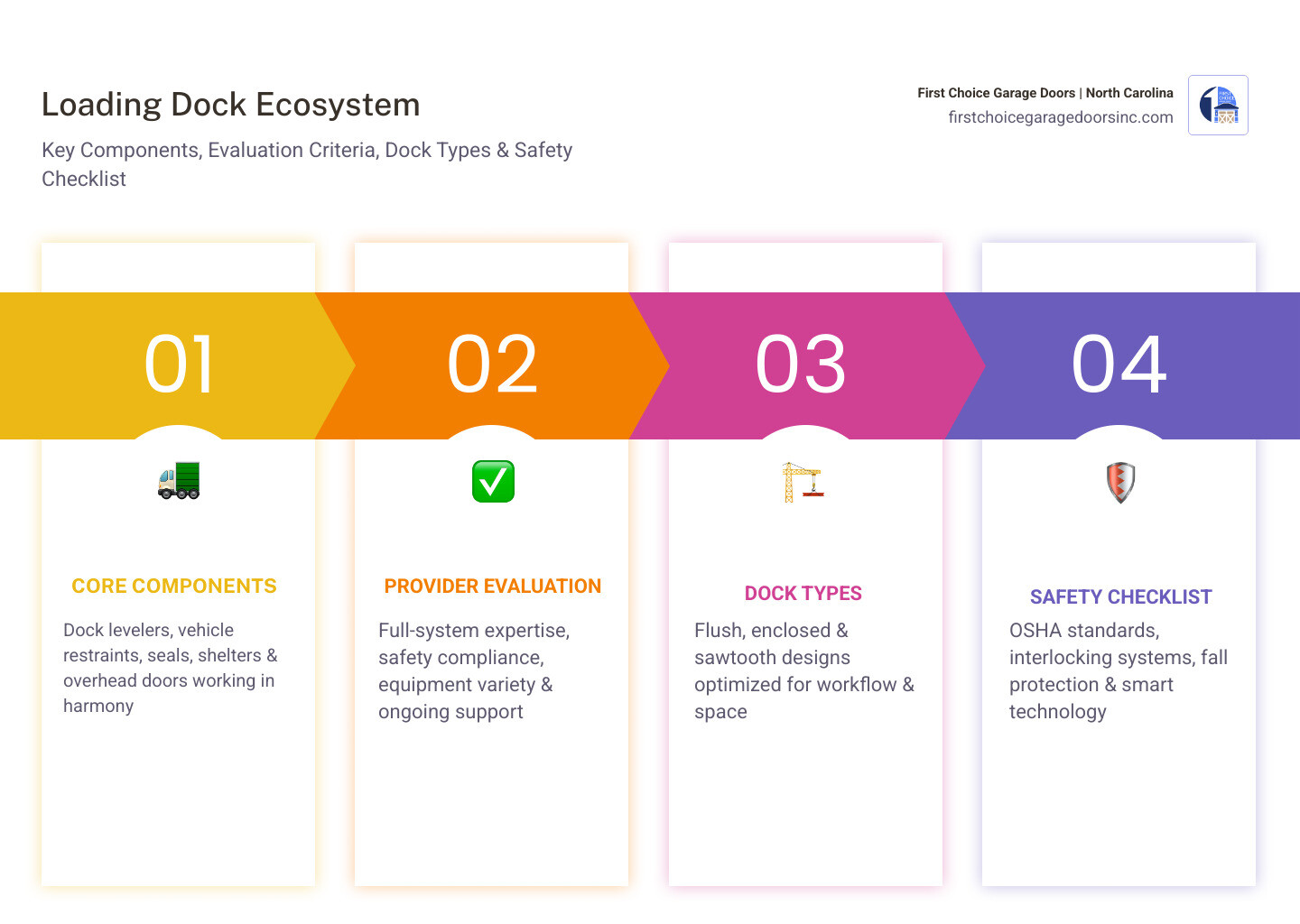
- Full-system expertise – dock levelers, vehicle restraints, seals, shelters, and overhead doors handled under one roof
- Safety and compliance knowledge – familiarity with OSHA standards and local building codes
- Equipment variety – ability to recommend the right dock type (flush, enclosed, sawtooth) for your specific workflow
- Ongoing support – preventive maintenance, emergency service, and long-term repair capabilities
- Technology integration – smart features, interlocking safety systems, and communication tools that reduce downtime
- Commercial door expertise – high-speed, insulated, fire-rated, and rolling steel door options matched to your operation
With over 10 million loading docks operating across the United States, the difference between a provider who truly understands commercial capabilities and one who simply sells equipment can directly impact your facility’s throughput, worker safety, and bottom line. The global logistics market surpassed $9 trillion in 2022 and is projected to reach $14.37 trillion by 2028 — meaning the pressure on commercial facilities to operate efficiently has never been higher. At the same time, 62% of online shoppers now expect free delivery in under three business days, putting real strain on every link in the supply chain, including the loading dock.
A loading dock isn’t just a doorway — it’s the critical interface between your facility’s interior operations and the vehicles that keep your business moving. When that interface is poorly designed, improperly equipped, or inadequately maintained, the consequences ripple outward: delayed shipments, injured workers, wasted energy, and lost revenue. The 2019 transportation and warehousing worker injury rate of 4.4 per 100 full-time employees is a stark reminder that these are high-stakes environments where the right provider partnership genuinely matters.
I’m Tony Aguilar, founder of First Choice Garage Doors with over 30 years of hands-on experience in commercial garage door systems and loading dock equipment — and choosing a provider with loading dock and commercial capabilities is something I’ve helped businesses navigate throughout my career. In the sections below, we’ll walk through exactly what separates a capable provider from a truly comprehensive one, so you can make a confident, informed decision for your Fayetteville, NC facility.
Essential Features for Choosing a Provider with Loading Dock and Commercial Capabilities
When we talk about “commercial capabilities,” we aren’t just talking about big doors. We are talking about an integrated system where every component must work in harmony to ensure the fastest and safest inflow and outflow of goods. A provider who understands this will prioritize a specific set of high-performance features.
The Core: Dock Levelers and Vehicle Restraints
The bridge between your facility and the trailer is the dock leveler. Whether you need mechanical, hydraulic, or air-powered pit levelers, your provider should be able to specify the right weight capacity and operational style for your volume. For example, while mechanical levelers are often cost-effective upfront, they require more frequent maintenance due to their many moving parts. Hydraulic systems, on the other hand, offer smoother operation and higher durability for high-throughput environments.
Equally critical are vehicle restraints. Accidents caused by a trailer disconnecting or “creeping” away from the dock are 100% preventable with the proper use of a restraint device. A comprehensive provider will insist on these as a non-negotiable safety feature. You can learn more about these specific components on our Loading Dock Equipment and Accessories Products and Services page.
Environmental Control and Commercial Doors
In Fayetteville, NC, keeping the humidity and heat out of your warehouse is a major priority. This is where Commercial Garage Doors Products and Services come into play. A provider with true commercial capabilities won’t just slap up a standard door; they will look at:
- Insulation values: Essential for climate-controlled or cold storage facilities.
- Cycle ratings: How many times the door opens per day.
- Speed: High-speed doors reduce the time the “envelope” of your building is open, saving massive amounts on energy.

The Essential Dock Equipment Checklist
A high-quality provider should offer a “turnkey” solution that includes:
- Dock Seals and Shelters: To create an airtight fit between the truck and the building.
- Heavy-Duty Bumpers: To absorb the impact of backing trailers and protect your building’s foundation.
- Dock Lighting: Internal trailer lights are vital for preventing forklift accidents inside dark containers.
- Communication Systems: Red/green light systems that tell drivers when it is safe to pull away.
Determining the Best Loading Dock Configuration for Your Needs
Not every warehouse is built the same, and your provider should be able to guide you through the architectural constraints of your site. The configuration you choose impacts your “truck court depth”—the space needed for a semi-trailer to maneuver. Generally, a minimum of 120 feet is required for efficient semi-trailer operations.
Common Dock Types
- Flush Docks: The most common type where the dock face is flush with the outside wall. It saves space but requires accurate seals to prevent energy loss.
- Enclosed Docks: The entire truck parks inside the building. This offers the best climate control and security but requires massive interior space and specialized ventilation for exhaust fumes.
- Sawtooth Docks: These are used when apron space is limited. By angling the docks, trucks can maneuver in tighter spaces, though it reduces usable interior floor space.
Comparing Dock Benefits
| Feature | Flush Dock | Enclosed Dock | Sawtooth Dock |
|---|---|---|---|
| Space Efficiency | High (Exterior) | Low (Interior) | Medium |
| Climate Control | Moderate | Excellent | Moderate |
| Construction Cost | Lower | Higher | Moderate |
| Maneuverability | Standard | High | Best for tight lots |
Whether you are looking for Commercial solutions for a new build or retrofitting an old facility, your provider should evaluate your specific traffic flow and vehicle types (from delivery vans to 53-foot trailers) before recommending a layout.
Safety, Compliance, and Modern Technology Integration
Safety isn’t just a “nice to have”—it’s a legal and operational mandate. A provider with deep commercial capabilities stays current with OSHA standards to ensure your facility avoids fines and, more importantly, keeps workers out of harm’s way.
Interlocking Safety Systems
One of the most significant advancements in modern dock safety is the interlocking system. This technology connects the vehicle restraint, the dock leveler, and the overhead door. The door cannot be opened until the trailer is locked in place, and the leveler cannot be deployed until the door is fully open. This prevents “early departure” accidents and fall-off incidents. For a deeper dive into these protections, see The Northern Virginia Guide to Loading Dock Safety and Protection.
The Role of “Smart” Technology
In 2026, we are seeing a massive shift toward data-driven docks. Modern providers can now offer:
- Real-time Tracking: Sensors that tell you exactly how long a trailer has been at a bay, helping you identify bottlenecks.
- Maintenance Alerts: Systems that track cycles and alert you before a spring breaks or a hydraulic seal leaks. This is why Why Maintenance is So Important for a Commercial Garage Door is a conversation we have with every client—predictive maintenance is always cheaper than emergency repairs.
- LED Safety Lighting: Advanced lighting that changes color based on the status of the dock, providing clear visual cues to both drivers and warehouse staff.
Frequently Asked Questions
What are the must-have features when choosing a provider with loading dock and commercial capabilities?
Beyond the leveler itself, you must prioritize dock seals and shelters to maintain your facility’s internal temperature. You also need to look for What You’ll Want With Your Commercial Garage Door, such as high-cycle springs and heavy-duty tracks. Don’t overlook the “small” things like impact bumpers and communication light packages—they are the first line of defense against building damage and worker injury.
Why is choosing a provider with loading dock and commercial capabilities critical for ROI?
A provider that understands the full ecosystem helps you avoid “unplanned downtime.” If a dock door is stuck shut, that bay is dead, and your shipping schedule is ruined. By implementing 3 Key Commercial Garage Door Maintenance Tips and choosing high-quality equipment from the start, you extend the longevity of your assets. Furthermore, proper seals and high-speed doors provide a massive return through energy efficiency, keeping your conditioned air inside where it belongs.
How do different dock types impact my Fayetteville, NC business?
In North Carolina, we deal with high humidity and varying temperatures. An open dock might work in some climates, but here, it leads to wet floors (a slip hazard) and skyrocketing cooling costs. Your provider should help you choose a configuration that meets local building codes while scaling with your business growth. If you plan to move from small box trucks to full semi-trailers in the next five years, your dock height and truck court depth need to reflect that today.
Conclusion
At the end of the day, your loading dock is the heartbeat of your warehouse. Choosing a provider with loading dock and commercial capabilities means choosing a partner who understands that if the dock stops, the business stops.
At First Choice Garage Doors, we bring decades of experience to every project in Fayetteville, NC, and the surrounding regions. We don’t just sell doors; we provide long-term support through preventive maintenance, expert installation, and a deep understanding of the logistics “big picture.” Whether you are building a new distribution center or upgrading an existing facility to meet the demands of 2026, our team is here to ensure your operations remain safe, efficient, and scalable.
Contact our Fayetteville, NC team for a professional consultation today, and let’s make sure your facility is equipped for the future of logistics.